Archivo:Foxhole radio from WW2.jpg
Ir a la navegación
Ir a la búsqueda
No disponible a mayor resolución.
Foxhole_radio_from_WW2.jpg (529 × 487 píxeles; tamaño de archivo: 88 kB; tipo MIME: image/jpeg)

Resumen
| Descripción |
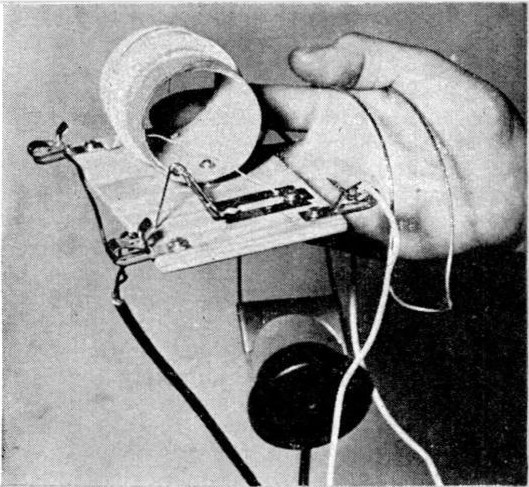
English: A "foxhole radio" receiver from World War 2. Not allowed powered radio receivers, which could give away their position to the enemy by the signal radiated by their local oscillator, American soldiers in World War 2 constructed their own homemade "crystal" radios so they could listen to news and music. The tuning coil (cylinder) was attached to a long wire antenna and ground. For a detector, this used a graphite pencil lead attached to the point of a safety pin, pressing against a "blue" steel razor blade. The graphite point touching the semiconducting oxide coating of the razor blade formed a crude point contact semiconductor diode which rectified the radio signal from the coil, extracting the audio signal from the radio frequency carrier wave, which was listened to with the earphones. The operator dragged the pencil lead across on the razor blade's surface until a sensitive spot was found and the station was heard, which required a lot of patience. The source says this foxhole radio belonged to Leutenant M. L. Rupert and was used on the Italian front. |
| Fecha | |
| Fuente | Retrieved February 10, 2010 from John W. Campbell Jr., "Radio detectors and how they work" in Popular Science magazine, Popular Science Publishing Co., New York, Vol. 145, No. 4, October 1944, p. 209 on Google Books |
| Autor | John W. Campbell Jr. |
| Permiso (Reutilización de este archivo) |
This 1944 issue of Popular Science magazine would have the copyright renewed in 1972. Online page scans of the Catalog of Copyright Entries, published by the US Copyright Office can be found here. Search of the Renewals for Periodicals for 1971, 1972, and 1973 show no renewal entries for Popular Science. Therefore the copyright was not renewed and it is in the public domain. |
Licencia

|
Este archivo se encuentra en el dominio público en los Estados Unidos porque fue publicado en ese país entre los años 1931 y 1963, y, teniendo un aviso de derechos de autor, no se renovó su protección. A menos que su autor haya fallecido años antes, se mantiene bajo propiedad intelectual en los países o zonas que no aplican la regla del plazo más corto para las obras estadounidenses, como China continental (50 años p.m.a., a excepción de Hong Kong o Macao), Alemania (70), Canadá (70), Suiza (70), México (100) y otros países con reglas particulares. Vea Commons:Hirtle chart como referencia e información.
|
 |
Historial del archivo
Haz clic sobre una fecha y hora para ver el archivo tal como apareció en ese momento.
| Fecha y hora | Miniatura | Dimensiones | Usuario | Comentario | |
|---|---|---|---|---|---|
| actual | 08:26 3 jun 2015 | | 529 × 487 (88 kB) | wikimediacommons>Chetvorno | User created page with UploadWizard |
Usos del archivo
La siguiente página usa este archivo:
